CONTENT:
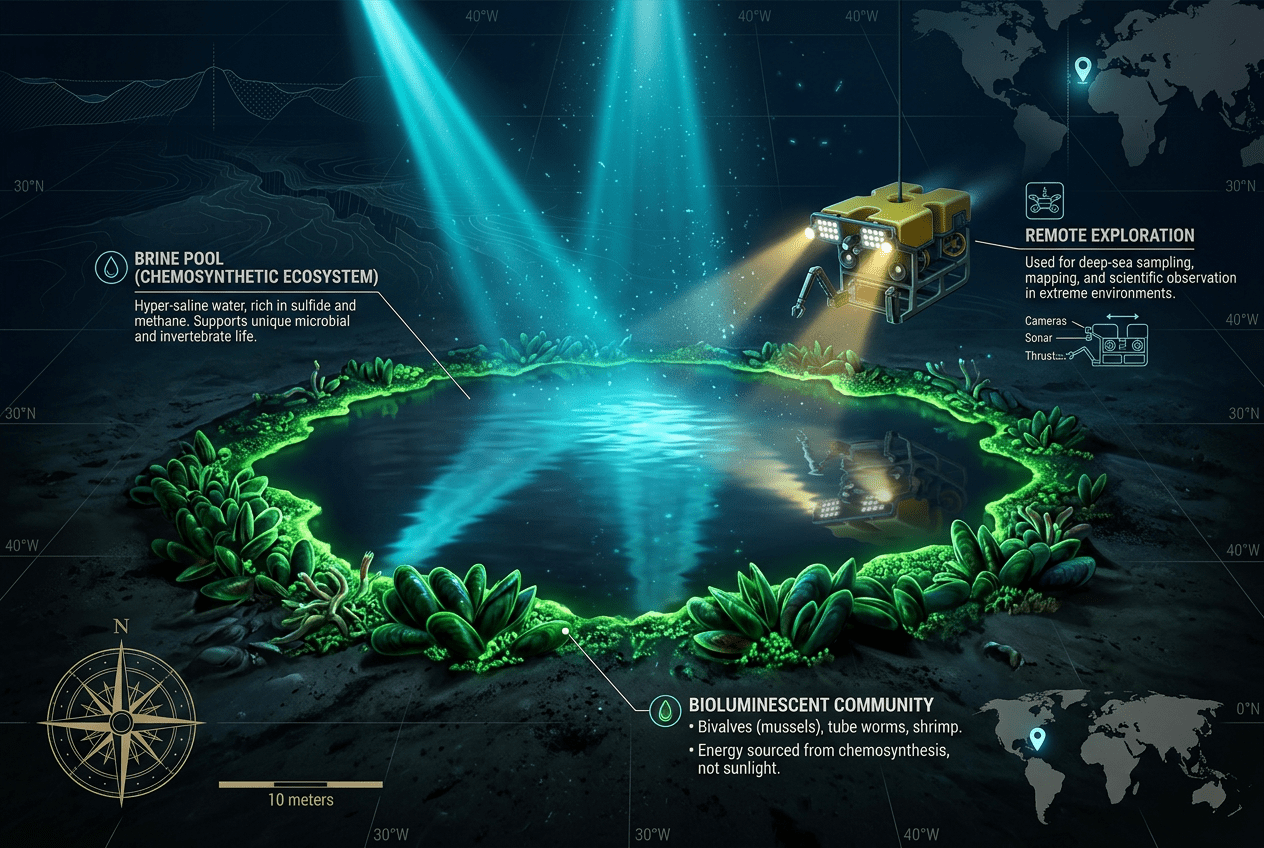
Imagine descending thousands of meters beneath the ocean’s surface, past the last flickers of sunlight, into a world of crushing pressure and near-freezing darkness. Then, improbably, you arrive at a lake. It has a shoreline. It has waves lapping gently at its edges. There may even be what looks like a beach. But you are still deep underwater — and this “lake” is one of the most hostile environments on Earth.
Welcome to the strange world of brine pools: bodies of hypersaline water so dense they refuse to mix with the seawater above them, pooling instead into distinct lakes and rivers on the ocean floor. Found primarily in the Gulf of Mexico, the Red Sea, and the Mediterranean, these underwater lakes are geographical oddities that blur the line between the familiar and the alien. They kill most creatures that stumble into them, yet they sustain some of the richest oases of life in the deep sea. And for scientists, they may be the closest thing we have on Earth to the oceans of other worlds.
What Exactly Is a Brine Pool?
A brine pool is a depression on the seafloor filled with water that is dramatically saltier — and therefore denser — than the surrounding ocean. Normal seawater contains about 3.5% salt. Brine pools can be four to eight times saltier, with salinity levels approaching saturation, meaning the water literally cannot hold any more dissolved salt.
This extreme density is the key to the phenomenon. Just as oil floats on water, ordinary seawater “floats” on top of brine. The two layers barely mix, creating a sharp visible boundary — a surface, complete with reflections, ripples, and waves when disturbed by currents or submersibles. Remotely operated vehicles (ROVs) have filmed these interfaces, and the footage is genuinely surreal: an underwater lake with a mirror-like surface, sitting quietly in the abyss.
Brine pools vary enormously in size. Some are mere puddles a meter across. Others, like the brine lakes of the Red Sea, span kilometers. The Orca Basin in the Gulf of Mexico is one of the largest known, covering roughly 400 square kilometers at a depth of about 2,400 meters — a true inland sea within the sea.
How Do Underwater Lakes Form?
The story of most brine pools begins millions of years ago, and it starts with geography on a grand scale.
Ancient Salt Deposits
During the Jurassic period, roughly 160 to 170 million years ago, the region that is now the Gulf of Mexico was a shallow, restricted sea in a hot, arid climate. As seawater repeatedly flooded in and evaporated, it left behind colossal layers of salt — a deposit known as the Louann Salt, in places several kilometers thick. Similar evaporite deposits formed beneath the Mediterranean during the Messinian Salinity Crisis around 6 million years ago, and beneath the Red Sea as Africa and Arabia rifted apart.
Salt Tectonics
Over geological time, these salt layers were buried under thick sediments. But salt behaves strangely under pressure: it flows like extremely slow-moving putty. In a process called salt tectonics, buried salt deforms, rises in domes and ridges, and sometimes breaches the seafloor. When seawater comes into contact with exposed salt, it dissolves it, creating super-saturated brine. Being denser than everything around it, this brine sinks into the nearest depression — often one created by the salt movement itself — and settles there, sometimes for thousands of years.
Hydrothermal Origins
In the Red Sea, geology adds another ingredient: heat. The Red Sea sits atop an active rift where the Arabian and African tectonic plates are pulling apart. Here, brine pools like the famous Atlantis II Deep are not only hypersaline but hot — with temperatures historically recorded above 60°C (140°F) — and enriched with dissolved metals like iron, zinc, and copper. These metalliferous brines have even attracted commercial interest for deep-sea mining.
Deadly Waters: The “Jacuzzi of Despair”
Brine pools are toxic to nearly all marine life, and not just because of the salt. They are typically anoxic — devoid of oxygen — and often saturated with hydrogen sulfide and methane. Any fish, crab, or other creature unlucky enough to swim or fall into the brine is quickly overwhelmed.
One pool in the Gulf of Mexico, discovered at about 1,000 meters depth, earned the grim nickname the “Jacuzzi of Despair.” Warm, briny, and lethal, its edges are littered with the pickled remains of crabs and isopods that ventured too close. Because the brine’s chemistry inhibits decay, some of these victims are preserved for years — natural mummies at the bottom of the sea.
Ironically, this preservative quality makes brine pools scientific treasure troves. The Orca Basin’s anoxic brine has protected layers of sediment from disturbance and decomposition, giving researchers pristine records of past climate and ocean conditions.
Oases of Life at the Edge of Death
Here is the great paradox: while the brine itself is deadly, the rim of a brine pool is often bursting with life. In the Gulf of Mexico, thick beds of mussels ring the shor