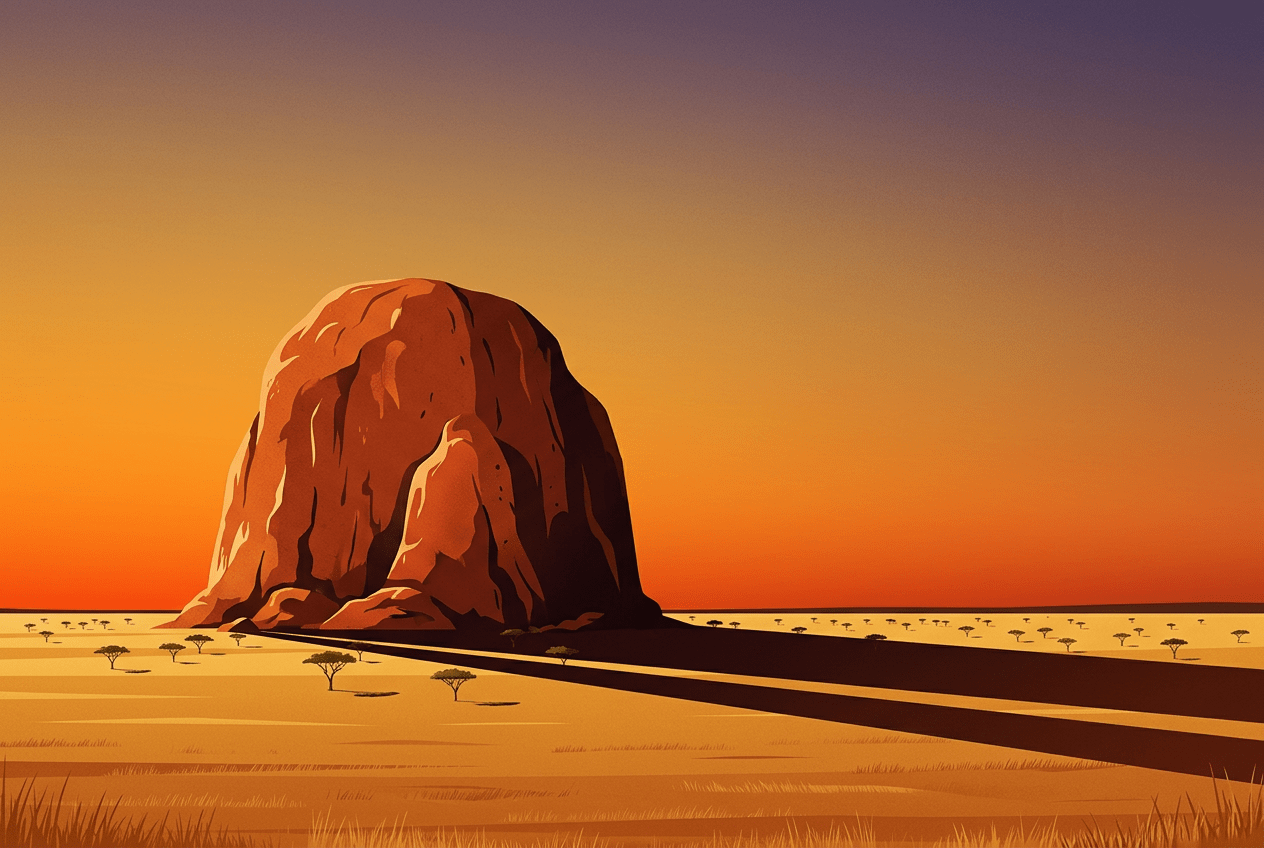
Imagine standing on a vast, featureless plain that stretches to the horizon in every direction. The land is flat, monotonous, almost oceanic in its emptiness. Then, without warning, a colossal mass of rock erupts from the earth — a sheer-sided mountain standing utterly alone, as if dropped from the sky. This is an inselberg, and few landforms on Earth are as visually dramatic or as culturally significant.
The word itself comes from German, meaning “island mountain”, and it’s a perfect description. Just as islands rise from the sea, inselbergs rise from plains of sediment and eroded rock. From Australia’s iconic Uluru to Brazil’s Sugarloaf Mountain, these lonely giants have captivated geologists, travelers, and indigenous cultures for millennia.
What Exactly Is an Inselberg?
An inselberg is an isolated hill or small mountain that rises abruptly from a gently sloping or virtually level surrounding plain. Unlike mountain ranges formed by tectonic collision, inselbergs are typically remnants — the last survivors of a landscape that has been almost entirely worn away around them.
Geologists recognize several types of inselbergs, each with its own character:
- Bornhardts: Dome-shaped, bald rock masses, usually made of granite or gneiss. Named after German geologist Wilhelm Bornhardt, who studied them in East Africa. Sugarloaf Mountain in Rio de Janeiro is a classic example.
- Castle koppies: Smaller, blocky formations resembling ruined castles, common across southern Africa where the Afrikaans word “koppie” (little head) gave them their name.
- Tors: Piles of rounded boulders stacked atop one another, found on the moors of Devon and Cornwall in England, among other places.
- Monadnocks: The American term, borrowed from Mount Monadnock in New Hampshire, often used interchangeably with inselberg in humid climates.
The Secret of Their Survival: Differential Erosion
The story of every inselberg is fundamentally a story of resistance. These landforms exist because of a process called differential erosion — the simple but powerful principle that not all rock erodes at the same rate.
Picture an ancient landscape, hundreds of millions of years old. Beneath the surface lies a mixture of rock types: soft sedimentary layers, fractured zones weakened by faults, and dense, crystalline masses of granite with few joints or cracks. Over geological time, water, wind, and chemical weathering attack this landscape relentlessly. The weaker rock crumbles and washes away, grain by grain, millennium after millennium. But the hardest, most massive rock bodies resist.
Eventually, the surrounding terrain is stripped down to a low plain — what geologists call a pediplain or peneplain — while the resistant cores remain standing, exposed as towering monuments to their own durability.
The Two-Stage Theory
Many inselbergs, particularly the granite domes of Africa, are thought to form in two stages. First, deep underground, chemical weathering works along cracks and joints in the bedrock. Where the rock is heavily fractured, groundwater penetrates and rots the granite into loose material. Where the rock is massive and unjointed, it remains fresh and intact.
In the second stage, erosion strips away the overlying weathered material, exposing the unweathered cores as fully formed domes. In a sense, the inselberg was “born” underground long before it ever saw daylight — sculpted in darkness and unveiled by erosion.
Famous Inselbergs Around the World
Uluru, Australia
Perhaps no inselberg is more famous than Uluru (formerly Ayers Rock) in Australia’s Northern Territory. Rising 348 meters above the surrounding desert plain and stretching 3.6 kilometers in length, this sandstone monolith glows a fiery red at sunrise and sunset. Remarkably, what we see is only the tip: the rock formation extends several kilometers below the surface, like an iceberg of stone. Nearby, the domed formations of Kata Tjuta (the Olgas) offer another spectacular example of resistant rock outlasting its surroundings.
Sugarloaf Mountain, Brazil
Rising 396 meters directly from the waters of Guanabara Bay, Rio de Janeiro’s Pão de Açúcar is a textbook bornhardt. Composed of granite and quartz roughly 600 million years old, its smooth, rounded profile is the result of massive, joint-free rock shedding its surface in curved sheets — a process called exfoliation, in which the rock peels like an onion as pressure is released.
The Granite Domes of the Sahel and Southern Africa
Across West Africa’s Sahel and the savannas of the south, inselbergs punctuate the landscape with startling regularity. Zimbabwe’s Matobo Hills present a maze of bornhardts and castle koppies, while Namibia’s Spitzberg formations rise like stone whales from golden grasslands. In Nigeria, Zuma Rock — a 725-meter monolith near Abuja — is so iconic it appears on the country’s 100 naira banknote. Cameroon’s Kapsiki Peak, a volcanic plug rising from the Mandara Mountains region, creates one of Africa’s most surreal skylines.
Stone Mountain, United States
Near Atlanta, Georgia, Stone Mountain is one of North America’s largest exposed granite domes, rising about 250 meters above the Piedmont plateau. Roughly 300 million years old, it formed as magma cooled deep underground and was later exposed as softer surrounding rock eroded away.
Sacred Islands in a Sea of Land
It is no accident that inselbergs are among the most spiritually significant landforms on Earth. Their sheer improbability — a mountain standing alone where no mountain should be — has inspired reverence in nearly every culture that lives among them.
For the Anangu people, the traditional owners of Uluru, the rock is a living cultural landscape woven into Tjukurpa, the foundational stories of creation. Every cave, waterhole, and fissure carries meaning, and climbing the rock was formally ended in 2019 out of respect for its sacred status.
In Zimbabwe, the Matobo Hills have been a spiritual center for thousands of years. The area contains one of the highest concentrations of rock art in southern Africa, and the hills remain a place of rainmaking ceremonies and ancestral veneration for the local communities. UNESCO recognized this deep cultural continuity by inscribing Matobo as a World Heritage Site.
Why do inselbergs attract such devotion? Geographers and anthropologists point to several factors. They are natural landmarks in otherwise disorienting terrain — fixed points for navigation, gathering, and memory. They collect water, harboring springs, pools, and unique vegetation that made them refuges in arid lands. And their visual drama simply demands explanation, inviting the myths and origin stories that bind communities to place.
Ecological Islands, Too
The island metaphor extends beyond appearance. Inselbergs often function as genuine ecological islands, hosting plant and animal communities distinct from the surrounding plains. Their rock pools, shaded crevices, and elevated microclimates shelter specialized species — some found nowhere else on Earth. Botanists studying the inselbergs of Brazil and West Africa have discovered endemic succulents, orchids, and resurrection plants that can survive total desiccation and revive with the rains.
Monuments to Deep Time
Perhaps the most humbling thing about inselbergs is what they represent: the sheer patience of geological time. Each one is the survivor of a landscape that no longer exists, standing hundreds of meters above plains that were once at its own level. When you gaze at Uluru or Sugarloaf, you are looking at the durable heart of an ancient world — everything softer has been carried away to the sea.
In a world of constant change, inselbergs endure. Lonely, yes — but far from forgotten.