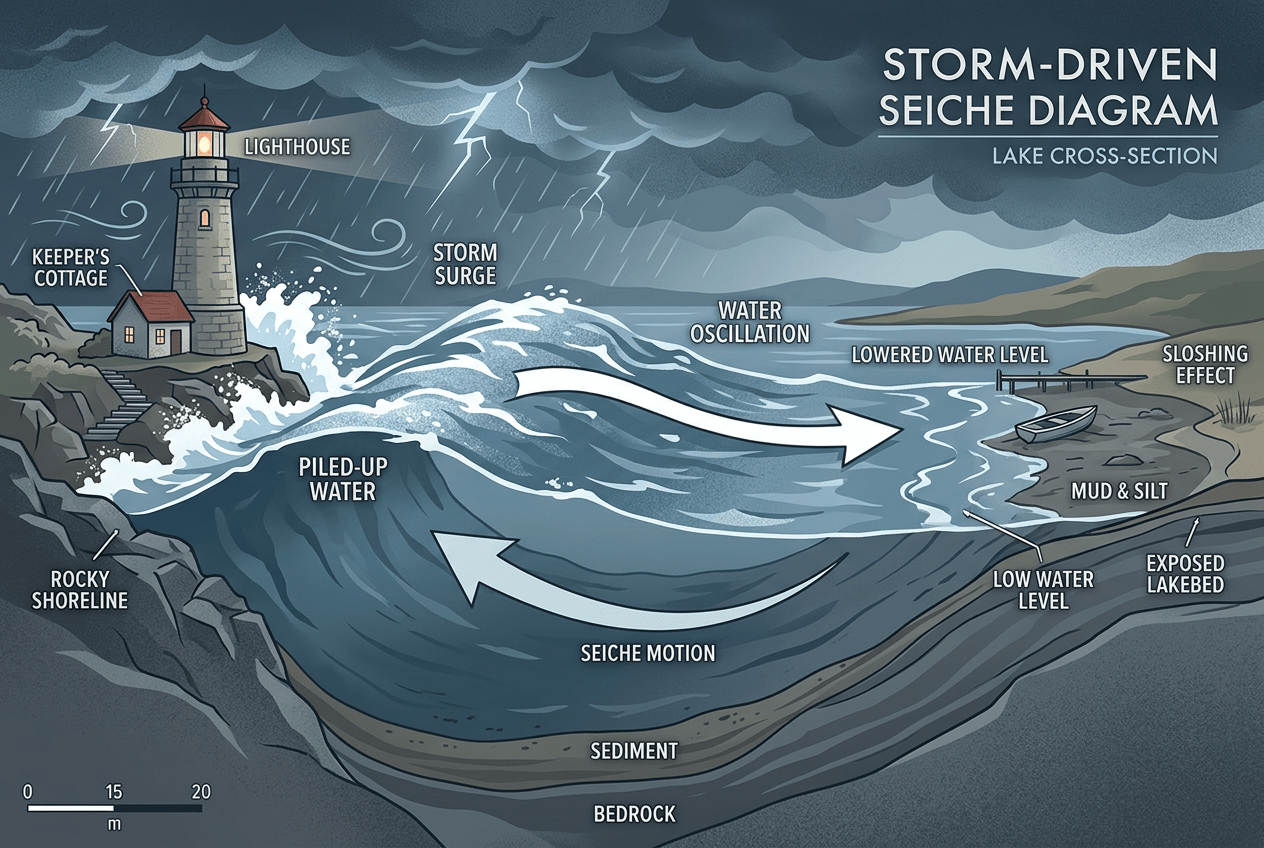
Imagine standing on the shore of Lake Erie on a calm morning, watching the water quietly recede—not with the tide, because the Great Lakes have no meaningful tides—but pulling back hundreds of meters, exposing mud flats, stranded fish, and forgotten shipwrecks. Meanwhile, 380 kilometers away in Buffalo, New York, that same water is piling up against the shoreline, flooding streets and marinas. What you’re witnessing is a seiche (pronounced “saysh”): one of the most fascinating and underappreciated phenomena in physical geography, in which an entire lake sloshes back and forth like water in a colossal bathtub.
What Exactly Is a Seiche?
A seiche is a standing wave that oscillates in an enclosed or partially enclosed body of water. Unlike ocean waves that travel across the surface, a seiche involves the entire water body rocking rhythmically from one end to the other. The term was coined in the 1890s by Swiss hydrologist François-Alphonse Forel, who conducted pioneering studies on Lake Geneva. The word comes from a Swiss-French dialect term meaning “to sway back and forth”—an apt description of what lakeside residents had observed for centuries.
The physics behind a seiche is elegantly simple. When you carry a shallow pan of water and it begins slopping from side to side, you’ve created a miniature seiche. In lakes, the initial “push” typically comes from one of several sources:
- Sustained strong winds that pile water up at one end of the lake
- Rapid changes in atmospheric pressure, such as those accompanying fast-moving storm fronts
- Heavy rainfall or flood inflows concentrated in one area
- Seismic activity, which can set water rocking even in swimming pools thousands of kilometers from an earthquake’s epicenter
Once the driving force relaxes—the wind dies down, or the pressure system moves on—the displaced water rushes back, overshoots, and begins oscillating. Depending on the size and depth of the basin, this rocking can continue for hours or even days, gradually losing energy with each swing.
Lake Erie: The Seiche Capital of North America
If seiches had a world capital, it might be Lake Erie. The lake’s geography makes it extraordinarily susceptible: it is the shallowest of the Great Lakes (averaging just 19 meters deep), and its long axis runs southwest to northeast—precisely aligned with the prevailing storm winds that sweep across the American Midwest.
When powerful southwesterly winds blow along the lake’s 388-kilometer length, water piles up dramatically at the northeastern end near Buffalo, New York, while levels plummet at the southwestern end near Toledo, Ohio. The results can be staggering. During a legendary storm in November 1972, the difference in water level between Buffalo and Toledo reached nearly 5 meters—an entire lake tilted like a serving tray.
These events are far from harmless curiosities. In 1844, a seiche driven by gale-force winds sent a wall of water over Buffalo’s seawall, drowning 78 people. More recently, in December 2022, a fierce winter storm produced a seiche that pushed Lake Erie’s waters more than 2 meters above normal at Buffalo, flooding waterfront neighborhoods amid a deadly blizzard. On the Toledo side, the same events can leave boats sitting on exposed lakebed and disrupt water intakes for municipal supplies.
Lake Geneva: Where Seiche Science Was Born
Across the Atlantic, the crescent-shaped Lake Geneva (Lac Léman), straddling the border between Switzerland and France, holds a special place in seiche history. Residents of Geneva had long noticed that the lake level at the city’s harbor would mysteriously rise and fall by tens of centimeters over the course of about 73 minutes, with no apparent cause.
In the 1870s and 1880s, François-Alphonse Forel—often called the father of limnology, the scientific study of lakes—systematically measured these oscillations. He demonstrated that they were standing waves whose period depended on the lake’s length and depth, and he derived mathematical formulas that still bear his name. Forel’s work on Lake Geneva essentially founded an entire branch of physical geography and hydrology.
Lake Geneva’s seiches are typically modest—usually less than a meter—but historical records suggest more dramatic events. Some researchers have even proposed that a massive wave documented in 563 CE, which devastated Geneva’s lakefront, may have involved a tsunami-like displacement caused by a sediment collapse, followed by prolonged seiche oscillations.
Harbor Seiches: Trouble in Small Packages
Seiches aren’t limited to great lakes. Harbors, bays, and marinas can experience their own oscillations, sometimes called harbor resonance or, in Japan, abiki. Because these basins are small, their natural oscillation periods are short—often just a few minutes—and they can be excited by long-period ocean waves, distant storms, or atmospheric pressure waves.
Some notable examples include:
- Nagasaki Bay, Japan: The infamous abiki phenomenon has produced harbor seiches nearly 3 meters high, snapping mooring lines and damaging vessels. A 1979 event caused waves of almost 4.8 meters and resulted in fatalities.
- Ciutadella Harbor, Menorca, Spain: Locals call these events rissaga. In June 2006, a dramatic rissaga drained the harbor and then sent a surge back in, damaging dozens of boats within minutes.
- The Adriatic Sea: Venice’s notorious acqua alta flooding is worsened by seiche oscillations in the Adriatic basin, which can prolong high water long after the initial storm surge passes.
Why Seiches Matter for People and Places
From a human geography perspective, seiches are a serious consideration for communities, planners, and engineers around enclosed water bodies:
- Flood risk: Cities like Buffalo must account for seiche-driven flooding in their coastal defenses, distinct from riverine or rainfall flooding.
- Navigation and shipping: Rapid water-level swings can ground vessels, strain moorings, and disrupt port operations on the Great Lakes and beyond.
- Water infrastructure: Municipal water intakes, power plant cooling systems, and wastewater outfalls can be exposed or overwhelmed when lake levels swing wildly.
- Public safety: Sudden water rises have swept anglers and beachgoers from piers. A 1954 seiche on Lake Michigan struck Chicago’s shoreline with a 3-meter wave, killing eight people who were fishing from breakwaters on an otherwise pleasant day.
Reading the Lake: Forecasting and Awareness
Today, agencies like the U.S. National Weather Service issue seiche warnings for the Great Lakes when strong wind events are forecast, using models that account for each lake’s unique geometry. Modern water-level gauges track oscillations in real time, and researchers continue to refine predictions of harbor resonance events like Japan’s abiki and Menorca’s rissaga.
Seiches remind us that even seemingly placid bodies of water are dynamic systems, exquisitely responsive to the atmosphere above them. The next time you visit a lakeshore and notice the waterline creeping oddly up or down without a storm in sight, you may be watching an entire lake breathe—rocking gently in a rhythm set by its own geography, a phenomenon first decoded on the shores of Lake Geneva more than a century ago.